


Free chord chart · 1 page · PDF
Stop guessing which chords go together.
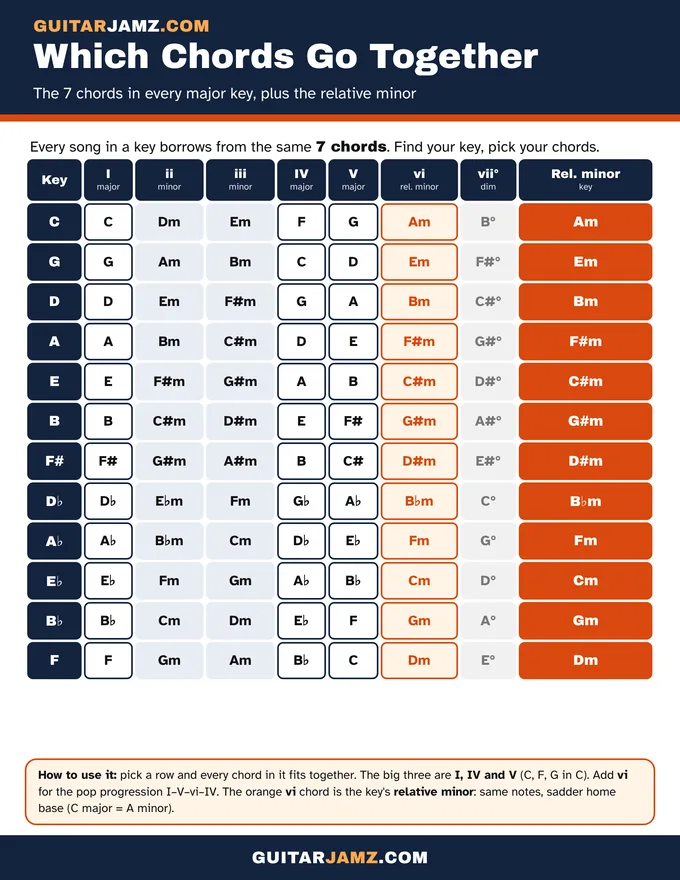
Every major key has seven chords that sound right together, and a relative minor key that shares the same notes. This free one-page chart lays out the seven chords of all 12 major keys, I, ii, iii, IV, V, vi and vii°, with the relative minor of each, so you can find the chords for a song, or write your own, without guessing.
We are finishing the chart. Sign up now and your thank-you page has a free lesson straight away. The chart will be there as soon as it is ready.
Trusted by 2.28 million guitar students
What you will learn in this free chord chart
- The seven chords of all 12 major keys in one table
- The relative minor of every key, marked in orange
- How to use it: the big three, I, IV and V, and the pop progression I, V, vi and IV
Questions
Is it really free?
Yes. It costs nothing and there is no card to enter. It is yours to keep: print it, save it or keep it on your phone.
What is a relative minor?
The minor key that shares its notes with a major key. It starts on the sixth note of the major scale: A minor for C major, E minor for G major.
Is there a quick way to find it?
Yes. From the root of the major key, go down three frets on the same string. Three frets below C is A, so A minor is the relative minor of C major.
What do the numbers mean?
Each Roman numeral is a chord’s place in the key. Capitals, I, IV and V, are major chords, small ii, iii and vi are minor, and vii° is diminished. In C that is C, Dm, Em, F, G, Am and B°.
Do I need to know music theory?
No. Find the key of a song you like on the chart, and every chord in that row fits together. Start with the big three, I, IV and V, like C, F and G in the key of C.
Is it for acoustic or electric?
Both. Keys and chords are the same on any guitar.
Free chords that go together chart
1 page · PDF. Free, no card, and yours to keep.
Get my free chord chart